
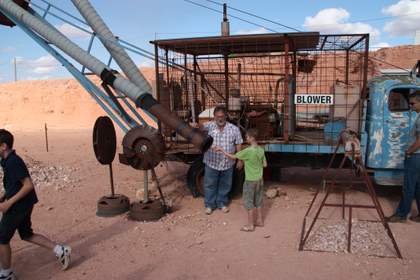
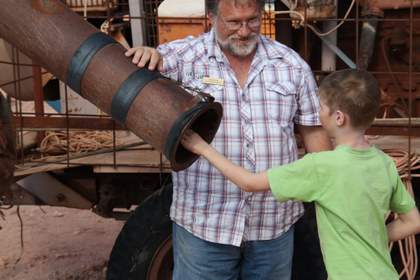
Really ugly. Every person we’d seen at the rest areas on our way up the Stuart Highway had given us warnings about Coober Pedy. ”You can’t free camp there, it’s just not safe.” ”There are huge cyclone fences around all the campervan parks and houses to keep people out.” ”Anything and everything will be stolen.” ”They’ll steel your stuff, and then try to sell it back to you.” In other words, we drove towards Coober Pedy expectations of a light-fingered town. Driving into Coober Pedy was even ugly. There are 1.8 million holes in the ground in the Coober Pedy region from opal mining. Apparently, an average of four tourists plunging down a mine shaft to their death every year. “Look!” I exclaimed when we finally caught sight of the town, “There are houses; above ground! I thought all the houses were underground.” Jarrad laughed at how silly this comment was, as we turned into the main street. There was lots of litter on the ground, burnt out cars in front yards and an un-kept feeling to the town. There seemed to be a lot of people sitting around the streets doing very little. Some were sitting alone, some were sitting in groups. A lot of them had dogs. They didn’t seem to be doing anything but just sitting — they weren’t even chatting to each other. It feels rather uncomfortable to walk past these groups of people just sitting there. The Old Timers Mine The ‘Old Timers Mine’ showed how mining had been conducted by hand in the early days of discovery. There was a ‘blower machine’ demonstration showing some of the machinery used in modern opal mining. Peter put his hand into the blower, and says that it felt like a vacuum cleaner.
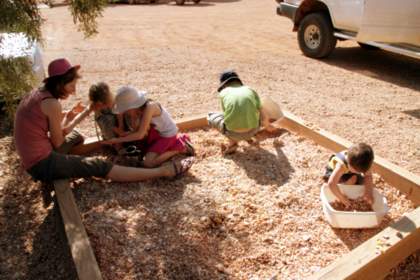
The highlight for the kids was a small box like a sandpit that they tossed a lot of their rejected items from mullock heaps into. This was for the kids to ‘noodle’ for opals in, meaning sift through the dirt looking for opals. Much of the finds were potch, which is a colourless opal. About 90% of the opal found is this valueless potch.
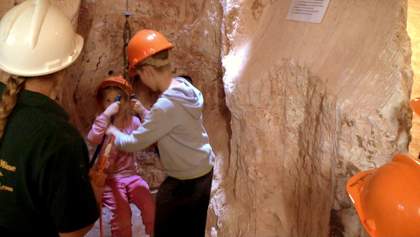
Susan and Peter managed to find a few bits that had flashes of colour. The local jeweller said two of Susan’s were good enough to be cut and polished. They came out much smaller but looking smooth and pretty with flashes of colour when they were rotated. The tour at ‘Tom’s working opal mine’ showed us the contrast to a modern opal mine. It all seemed like pot luck to Mum and Dad with no logic behind where to dig. They used divining rods to decide which direction to dig in. They demonstrated how they made and used explosives to blast out sections of the mine.
The machines at most of the mines had to run on diesel generators for electricity. They said it costs $500 each day to mine the opals using the modern techniques due to the drills, generator electricity and explosives.


Latest posts by Amy and Jarrad (see all)
- While in Sydney - January 24, 2013
- Festivals Around the World - January 23, 2013
- Off to Sydney - January 18, 2013
 About Amy and Jarrad