
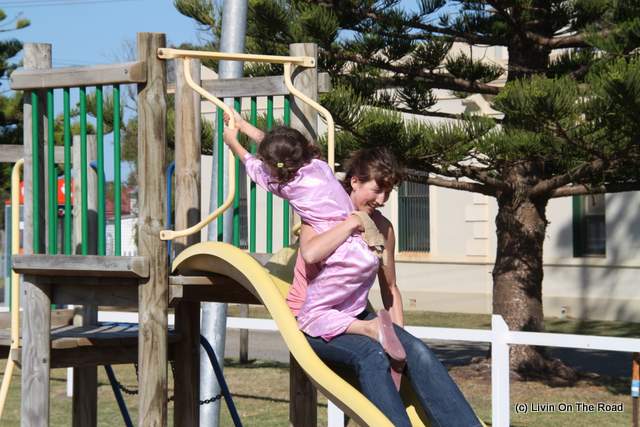
Amy and Susan on the slide. Camping next to a playground means that kids escape before breakfast and getting dressed sometimes.
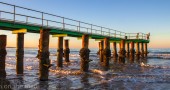
We could camp for free on the foreshore, next to playground with toilets, barbecues and water. I got out Edmund’s plastic crawl-through tunnel and untied it for the kids to crawl through. That was a misstake! The wind was really strong, and we all had to chase it as it blew away.
“The baby seagulls have grey legs, beaks and circles around their eyes. The adults have red instead of grey.” Susan told Lucy as the girls threw their chips to the birds, even though we asked them not to.
“Have you been reading Samantha Seagull’s Sandals?” I asked them.
Susan shrugged, “Of course.”
“That island over there is Snake Island, and that land next to it is Little Snake Island,” Peter kept telling us, “I wonder if the big snakes live on Snake Island and the baby snakes live on Little Snake Island.”
The Maritime Museum
We were all surprised by the maritime museum. It was at the old State Bank of Victoria building, that had been built back in 1852. There were stories of shipwrecks, the gold rush, and Aboriginal myths told around the museum. Old coins and pretty shells were displayed. There was equipment from old ships.
Peter, Susan and I took turns to read aloud the history of the port. We learnt that it was the oldest port in Gippsland, and during the gold rush it had serviced the entire region. They claimed it almost rivaled Melbourne as a port, until the port at Lakes Entrance increased in popularity. The improving road and rail network to Gippsland meant it was no longer as important.
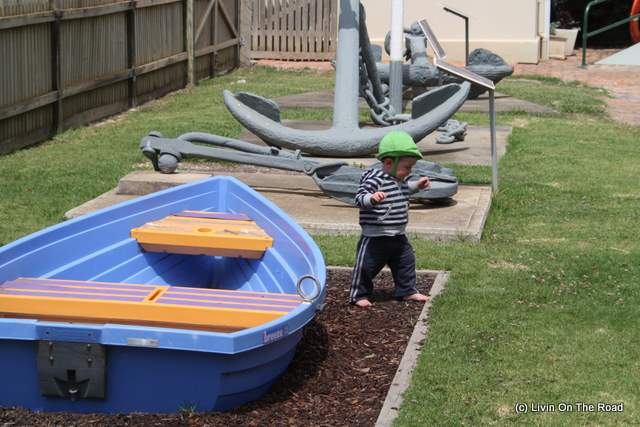
"Little Edmund' at the maritime museum.
In the afternoon we went for a walk on the wharf and foreshore. The wind was gale force and irritated us all. It made Mum short tempered and grumpy. Mum said, “Edmund’s tired, I better take him back to the campervan for a sleep.”
Dad laughed and told Mum, “We will all go back out of this wind. We’ll go for a drive and explore a little further afield.”
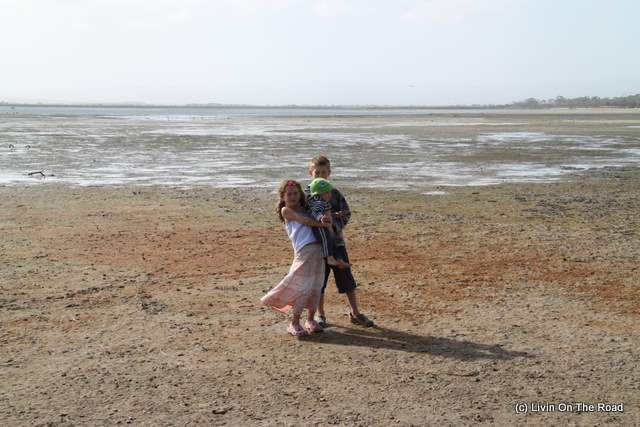
We drove slightly out of Port Albert and found a coastal park at low tide. There was a narrow line of shells that Kalina fossicked in, then a wide expanse of mud that was home to thousands to mud crabs and shrubs that were possibly tea trees. We walked along the mudflaps with Mum carrying a sleeping Edmund and all got muddy feet. Dad protested about allowing the muddy shoes in the car, but everyone just laughed at him as they clambered in.
We drove through Mann Creek, but the GPS was telling us we were in Tarraville.
“It must be wrong,” Jarrad said, “There’s not even a pub. Every town has a pub.”
“I can’t see a war memorial, every town seems to have a war memorial.” added Peter.
“Those buildings over there look like they are about to fall down.” Susan told us, pointing to the few buildings around.
A little later, Susan said, “I need the toilet.” I walked with her up a narrow path to the toilets. It was the typical drop toilet, though this one had a lever to pull with a sign saying to pull it after … we took turns pulling the lever alternating with staring down the toilet to try and see what it did. We giggled, and giggled, and gagged with the smell, but neither of us could see any effect from moving that lever.
Tarraville
On the way back to the campervan still parked at Port Albert, we paused to drive around a few streets that the GPS was supposing may be Tarraville.
One building had a sign outside saying ‘school – public hall – museum’. ”Oh, the poor kids that go there! The school’s a dump.”
Peter pointed at a sign and said, “Dad, there’s a historical marker! Can we read it?”
We drove back to the main road where the sign was located and we could see it from the window as I read it aloud. It showed a map, and described the Catholic Church that had stood in that place. It had apparently at one stage been the centre of the Catholic dioceses of Gippsland.
“Look!” Susan pointed to another board saying: “Tarraville 1844 – 2001” and continued to describe the history of the former township.
Tarraville had been a bustling township with around 100 mainly brick buildings that included a police station, jail, three pubs, four churches, a school and private residences. People landing at Port Albert had stopped at Tarraville for provisions and the fresh water sourced from the Tarra River that the town was located on.
We were intrigued by the history of the former town, and the few boarded up, derelict buildings. Jarrad and I wanted to know more about how a town gets “de-gazetted”.
“Look at that!” Peter pointed as he spotted one house that was so run down it looked like it would topple down. It had just a flywire front door over a verandah, and we tried to peer through it from the safety of the car but without success.
Excert from Susan’s Diary (aged 7)
Port Albert, Victoria
I woke up, ate and played for a while and then I went for a walk and then we went to the museum and there was a lot of interesting information and history. And I took some pictures of documents so I could read them whenever I want and there was a whole big collection. I got a couple of shells from the beach and then we went to the post office.


Latest posts by Amy and Jarrad (see all)
- While in Sydney - January 24, 2013
- Festivals Around the World - January 23, 2013
- Off to Sydney - January 18, 2013
 About Amy and Jarrad